Total Pageviews

Showing posts with label plein air. Show all posts

Wednesday, February 13, 2013

Shadow Study

Shadow Study
Painting No. 6-B-13
8" x 10"
Oil on canvas panel

This afternoon I ventured outside for a few hours of painting on location. I settled on this shadow study of the Rabbit Brush and boulders along the Colorado River. It's a classic example of my head not being totally focused on the compositional qualities of the painting. Never-the-less, after repainting the Rabbit brush 3 times I finally got some shadow color that I liked. This painting will be used as a color reference for a larger studio painting, but wont be hung for sale.


Things to consider:
Only 1 in 30 plein air paintings are really the quality to be shown in a gallery.
Do you, as an artist, hold onto your studies for future reference?
How many plein air paintings to you produce each year?


Thursday, January 24, 2013

Developing Large Paintings from Plein Air Sketches

Developing large oil paintings is part science, part art and a certain amount of planning and intuition. In the end even the best painters can mess it up and have to restart, so don't beat yourself over the head if it takes you several tries..or 50 tries to get it right.

Let me say that I study art manuals all the time. I'm continuously trying to improve my techniques and you should too.

I'm working on producing my first large work since arriving in Moab. It's based on the plein air painting I did on Monday called, "Winter Breath". Above is a full scale 16" x 20" pencil drawing that I've reworked about 6 times in the last 2 days. Notice the lines drawn at the 1/3 and 2/3 distances both horizontally and vertically. Also note the lines from corner to corner. These 6 lines are crucial for laying out the objects within the painting, including the lead in line.

You should know that I took photos the day of the plein air, then I went back out yesterday and shot a dozen more detail shots of rocks, bushes and canyon walls. the details will become important in the negative space for adding detail to shadow areas.


Below is the plein air sketch that I will use for all color references....DO EVERYONE A FAVOR AND RELY ONLY ON YOUR PLEIN AIR PAINTINGS FOR COLOR REFERENCES. PHOTOS ARE ONLY GOOD FOR SHAPES!!! In the next blog I will cover the actual canvas techniques that I used.

Wednesday, January 16, 2013

Moab Visitor Center in Snow

Moab Visitor Center
Painting No. 1-A-13

I was in the gallery most of the day and at some point I decided that I needed to paint plein air (out in the open) but the temperature never got above 18 degrees today. So I set up my paint kit in the gallery and worked out the window towards the Moab Visitor Center. The mountains pictured are south of town and are known as "Behind the Rocks".

I thought the cool blues combined with red-ish shadows and dead leaves worked well. Your thoughts?

Tuesday, November 13, 2012

Breaking Dawn


Breaking Dawn
Painting No. 2-K-12
30" x 40" oil on canvas

This is a view of Dead Horse Point in Southeast Utah. I was there at dawn painting small sketches for larger works and I fell in love with the lighting of this particular monolith.
So let me ask for your comments; Did I capture the scene correctly? Do you like the composition?

Saturday, November 10, 2012

A Hunter's Dream


A Hunter's Dream
Painting No. 17-J-12
8"x 10"
oil on canvas board
 
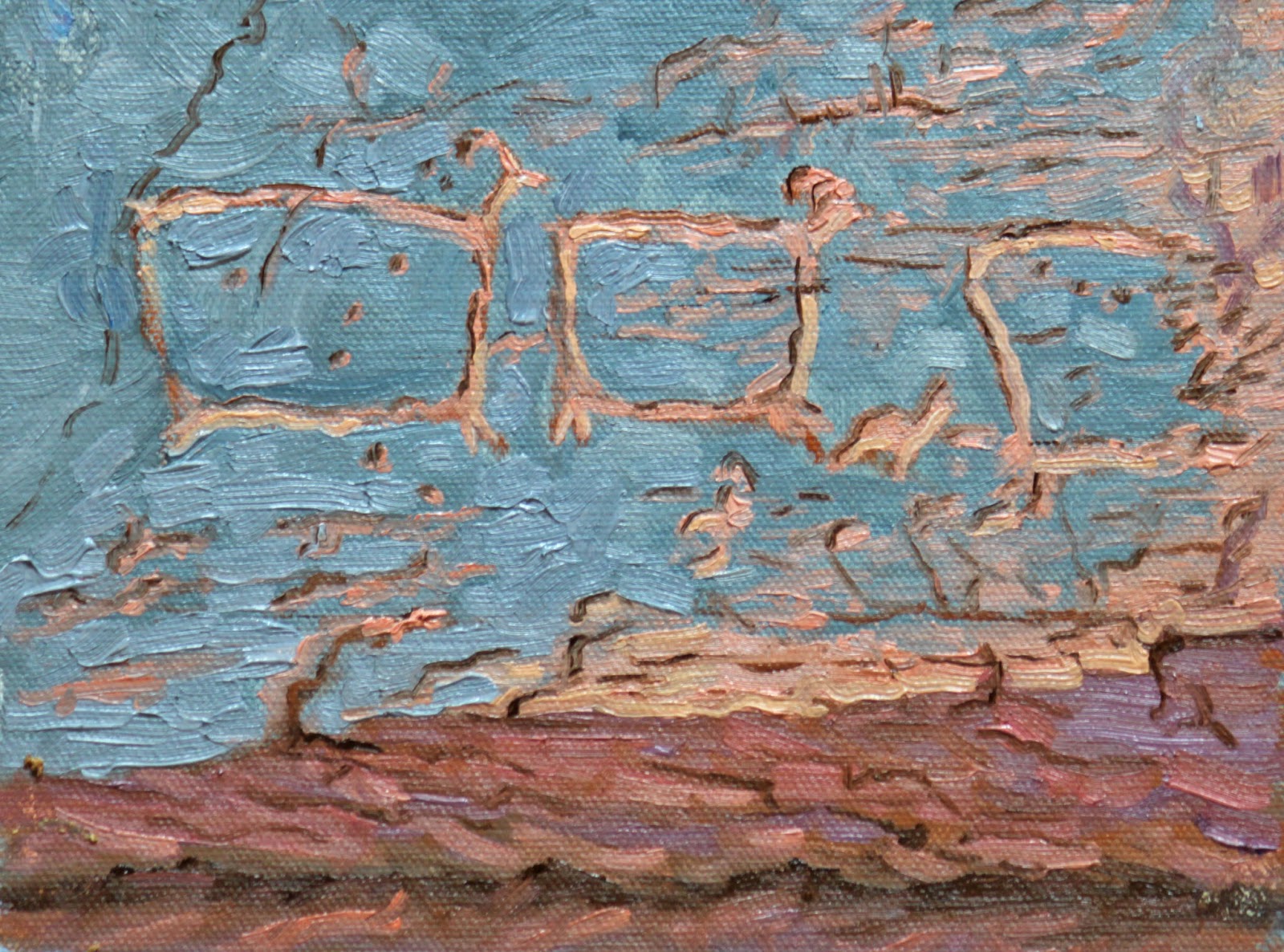
I was introduced to these petroglyphs by some locals while I was painting on location outside of Moab, Utah. This group is called the "TV Sheep" because of their obvious shape. The biggest sheep is approximately 16" tall. It's assumed that the images date between A.D. 500 and A.D. 1500. The countryside is full of similar examples of rock art, and I really enjoyed every one that I came across during my stay.


Thursday, August 9, 2012

Back Forty

Back Forty
Painting No. 3-H-12
8"x10" oil on canvas board

Beautiful hot summer weather prevailed in Teton County during the Driggs Digs Plein Air Festival in Driggs, Idaho last week. This painting is from just outside of Tetonia, a small ranching community near Driggs. Within 50 miles of Driggs you could paint an entire career and never repeat the same scene.

Monday, July 2, 2012

Elders of the Forest

Elders of the Forest
Painting No. 7-F-12

During the Markleeville Plein Air Festival I came across these stout trees that overlooked Faith Valley California and decided to try and capture their steadfast strength and beautiful patterns in the exterior trunk.

Tuesday, May 22, 2012

Along the Madison River

Along the Madison River
Painting No. 8-E-12
8"x 10", oil on canvas panel

This is an afternoon painting of the Madison River in Yellowstone National Park. My wife and I were there last week and I had the chance to paint nearly everyday.

Tuesday, May 8, 2012

Sierra Patterns

Sierra Patterns
Painting No. 6-E-12
10"x 8"
oil on canvas

During my Saturday drive along the Eastern Sierra Nevada Mountains, I painted this scene in mid-afternoon, just west of Grant Lake. The snow is melting fast on all the surrounding areas.

Sunday, April 15, 2012

Spring Weather
Painting No. 2-D-12
8"X10" oil on canvas

Typical weather for this time of year. A mix of snow showers, clouds and partial sun.
The wind stopped blowing long enough for me to capture this local ranch in the Carson Valley.

Saturday, January 7, 2012

New Year's Eve 2011

Painting No.156
New Year's Eve 2011
Bently Ranch
Minden, Nevada
8"x 8", oil on linen
December 31, 2011

Strong beautiful color on these warm winter afternoons. I passed this site several times over a week before finally stopping.
Here's to a solid year of great paintings!

Saturday, December 17, 2011

Color Studies as a Design Tool.

I thought I would share a design tip.
Though I usually paint my subjects outside "plein-air" then bring the paintings indoors to develop a larger painting, this time I worked from a photo of this hotel, which I adjusted the dimensions to fit what I wanted the painting to convey,  then I painted 3 small studies to see which lighting condition looked the best. My initial thought was to go with the Evening Light version, but then I brought my wife in and had her look at the paintings and give me her initial response, which I think is vital to the process, since my decision can be skewed by spending too much time staring at the canvas.

Tell me what you think. Which one would you pick? If you were painting this scene, what mood would you want to express to the viewer?

Daylight study
 
Evening light study 
  
Night study


Friday, September 2, 2011

Water Tower

Painting No. 130, Water Tower
Stewart Indian School, Carson City, Nevada
8"x 8", oil on linen panel
September 1, 2011

Standing over the facility, like a giant sci-fi robot, the water tower is surrounded by trees and buildings. It's silvery exterior reflecting the local color.
This is painting 6 of 10 in a series painted at the school.

Tuesday, August 30, 2011

Bunkhouse Deluxe

Painting No. 128, Bunkhouse Deluxe
Sossa Brothers Cow Camp, Alpine County, Ca.
9"x 12", oil on linen panel
August 14, 2011

I took off for Ebbett's Pass in the hope of finding a stream or lake to paint but nothing was catching my eye. Then I came around a curve and noticed the bunkhouse just off the road, I couldn't resist.
It was probably built in the early 60's when steel and aluminum were constructed to last forever. Now with it's after-market wooden screen door, smoke stack and sagging porch it probably doesn't see much action except for a few brave cowboys in the fall.

Tuesday, August 23, 2011

Painting from Small to Large Paintings Part 2

After selecting your subject matter, painting field sketches and photographing the scene, the next step is to lay-in the basic line work.
Start by blocking in a background wash, green for the tree area, blue for distant mountains, yellow for the sky. Since the subject is well known in the Sierra's, I took the time to properly lay-in the correct height, width and location of all objects. To accomplish this I used several photographs and I drew a grid system directly on the photo then transferred the scale proportionately to the canvas using a small brush and French Ultramarine paint.


Next I worked back to front, painting the distant mountains in detail, then the mid ground mountains, again in detail leaving the sky for the end. In this photo I have also painted the closest shadows of the willows that grow in the meadow. This is my reference to compare all other values against.

Thursday, July 21, 2011

Stewart Facility

Painting No. 120, Stewart Facility
Carson City, Nevada
8"x 8", oil on linen panel
July 21, 2011

The Stewart Facility was built as a native american school in the early 1900's. The buildings are now used by several different organizations, many buildings are boarded-up and in a state of slow decay. I'm going to spend the next couple of weeks painting various buildings, like this small office that was made out of local quarried stone, with a steel roof.

Monday, July 11, 2011

Aspen Afternoon

Painting No. 116, Aspen Afternoon
Buckeye Creek, California
8"x 6", oil on linen panel
7-3-2011

Buckeye Creek is a great getaway-from-it-all destination. It's 4 miles from Bridgeport California if you need something to do. It's 3 miles from Twin Lakes & Mono Village which is usually jam packed with campers and fishermen from Southern California. It's about 20 miles to the east entrance of Yosemite, and it's 10 miles to the ghost town of Bodie. But the best part of Buckeye is the peace and quiet of the streams and forest that surround this place. These aspens are just about the creek, next to a meadow. The first night of the trip we watched deer graze here at dusk. 

Wednesday, July 6, 2011

Evening Light, Buckeye Creek

Painting No. 115, Evening Light, Buckeye Creek
Bridgeport, California
6"x 8", oil on linen panel
7-2-2011

The day was hot in the mountains, probably in the mid 80's. But in the late afternoon things start to cool off rather quickly at higher elevations. I moved down to the creek and found this composition just below the campground. People filter past be as they enjoy walking through the shadowy corridor. I set up and paint quickly as the light traverses across the narrow opening in the trees and disappears into the mountains, leaving only the fading glow of the evening for me to work with.

The relationship between the fallen trees and the boulders work in harmony to create an "S" shaped design line. This, combined with the strong vertical and angled elements helps the painting to hold the viewers interest

Thursday, June 30, 2011

Raymond Peak, Late Spring

Painting No. 112, Raymond Peak, Late Spring
Alpine County, California
6"x 8", oil on linen panel
6-26-2011

Raymond Peak was named in 1865 for the mineral examiner Rossiter W. Raymond. It's peak elevation is 10,023 ft above sea level, with rocky volcanic composition and surrounded by lower, rolling, pine covered mountains. The Pacific Crest Trail passes to the east and north of the peak and is probably still covered in 3 feet of hard packed snow as of late. Getting the chance to paint in these mountains is just another reason why the Sierra's are such a wonderful mountain range to explore.

Tuesday, June 28, 2011

Sierra Afternnon, with Hawkins Peak

Painting No. 111, Sierra Afternoon, with Hawkins Peak
Alpine County, California
8"x 6", oil on linen panel
6-25-2011

Last weekend my wife and I stayed in a campground outside of Markleeville, California. This was the same campground where my grandparents brought my brother and I each summer and we would stay for up to a month back in the early 1980's. The terrain is a small bowl shaped valley, surrounded by low hills on all sides.

These pine trees with the slight hint of the south slope of Hawkins Peak was the best composition I could find. I painted in the early afternoon, concentrating on adding additional detail of the tree's branches and varying the shades of shadows within the fading forest.